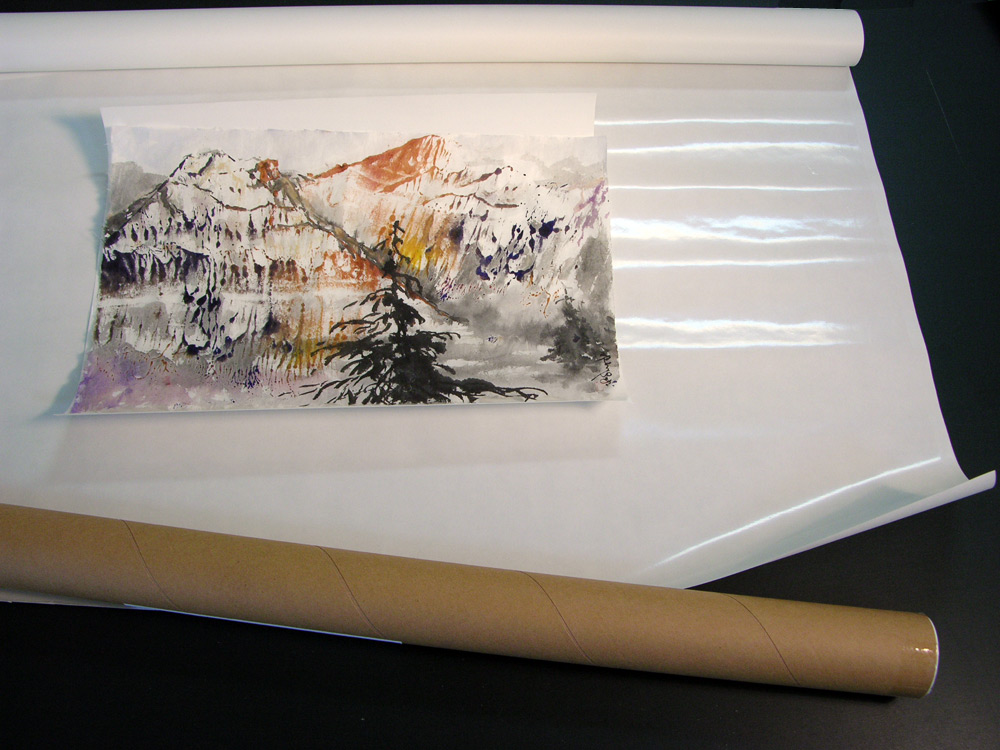
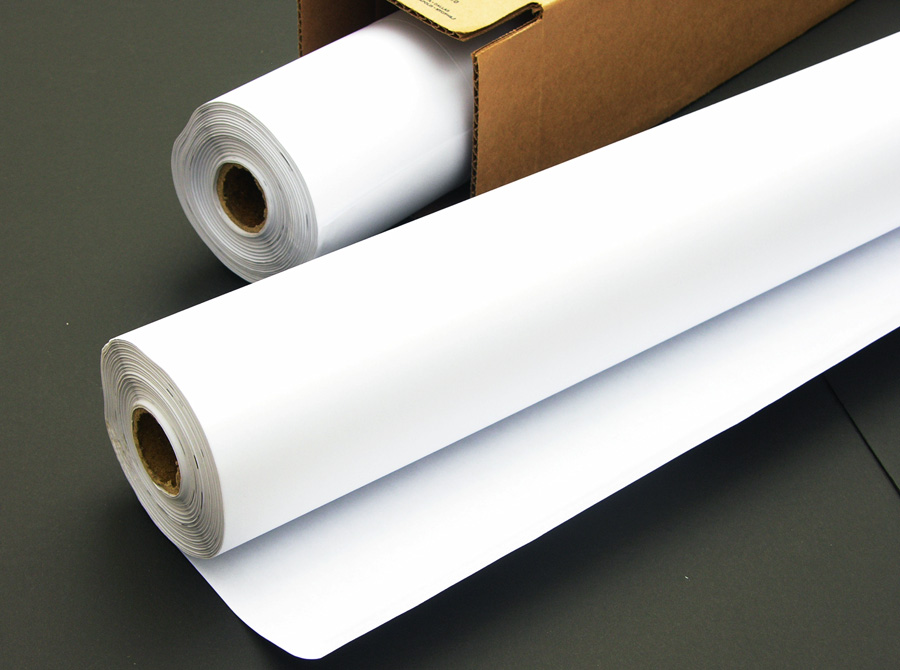
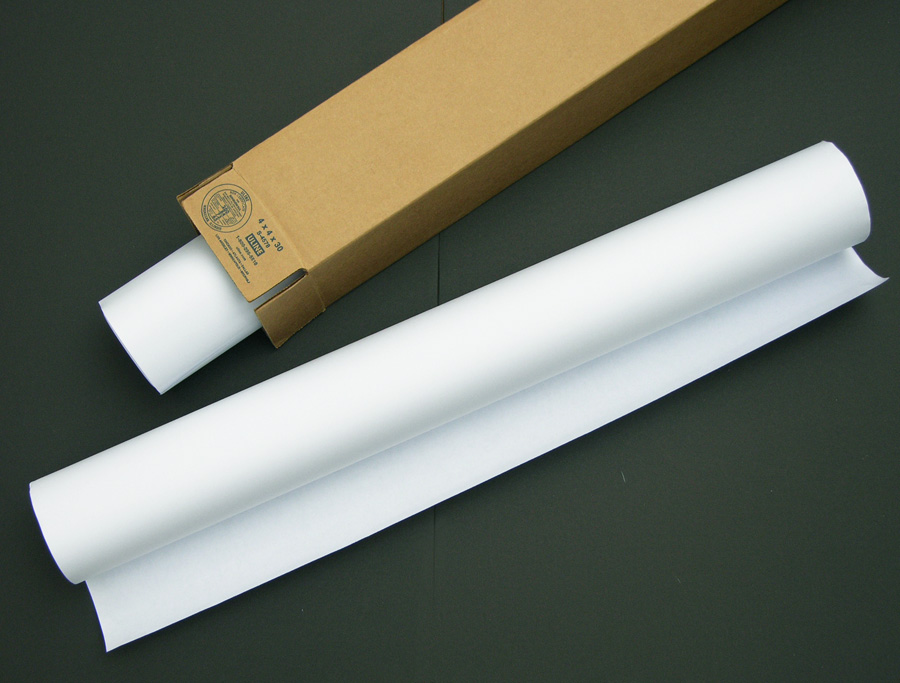
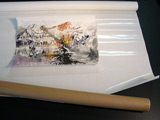
Silicone Adhesive Paper for Dry Mounting Chinese Brush Painting or Sumi-e.
Measurement: 26.5 inch(69cm) actual usable width and 10 yards(914cm) long.*
* If you buy multiple units(20, 30 yards or more) we will cut into a continuous single roll by default. If you want your multiple 10-yard order being cut separately, please make a special request in your order comment area. Thank you!
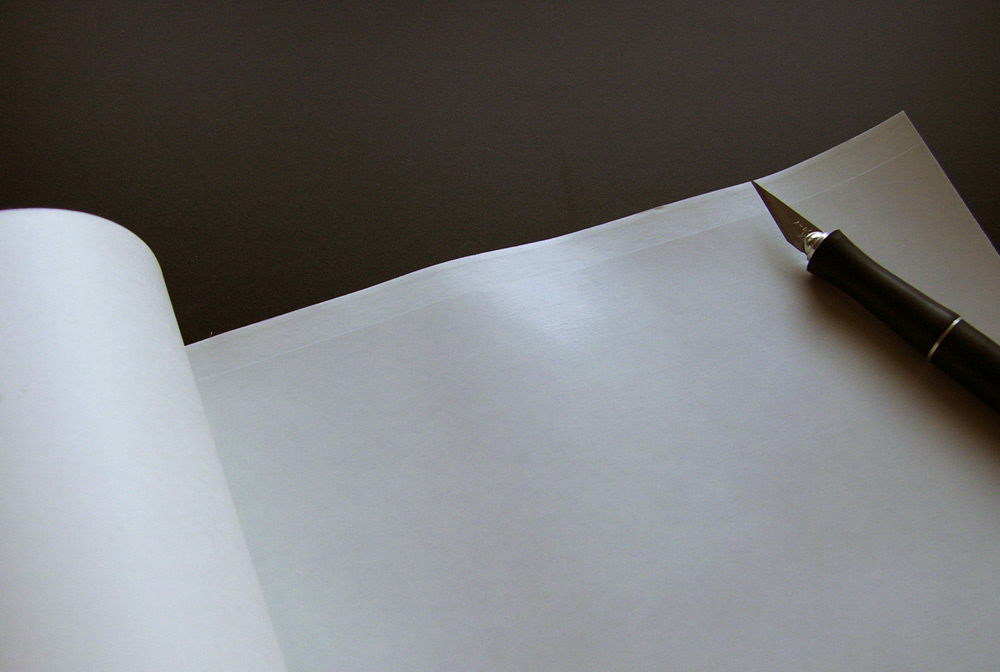
Silicone Paper is easy-to-use heat-sensitive for dry mounting. Silicone is coated on one side of the release paper. The acid-free/archival adhesive melts at 180F heat and bonds to paper, fabric, plastic, wood, etc. as it cools off. It flows under heat and pressure and can be patched, overlapped and pieced together. The release paper keeps adhesive film clean and makes adhesive film easy to handle and protect the artwork and the iron or press machine.
Great for dry mounting thin papers, rice paper, tissue paper, parchment, watercolors, silks, and other fabrics.
Mounting Method A: Mount to the back of the painting
In this method, the original painting is mounted directly to the silicone paper first, then transferred on to a permanent backing support. We don't suggest beginners to use this method.
Mounting Method B: Mount the backing material first
This method is to transfer the silicon adhesive film to the backing material first, then take the release paper off and mount the painting on it.
Here are the steps:
1. Cut the Silicone Release Paper to the same size as the backing paper or board or a little bit smaller than the painting size.
2 Place the silicone release paper, film side facing down, on the mounting paper (museum board, foam board, vellum, watercolor paper, bristol paper, etc)
3. Iron at 180 degrees F or “silk”. No water spray is needed. For best result use 4 layers of denim cloth under the backing paper before ironing.
4. Peel off the release paper, mark the waxy side that facing the silicone, and save it for use in step 7.
5. If necessary, trim any extra adhesive film along the board edge with a cutting knife or a pair of scissors.
6. Lightly spray the front of the painting with a little bit of clean water to relax any wrinkles.*
7. Lay the artwork face up on the adhesive film and cover it with the release paper from step 4.
8. Now it's ready to iron: moving from the center out, first the cross and then in X movements towards corners to drive air all the way outside the painting. Keep the iron moving and don’t stop in one place.
9. Check the result and if you see any creases you may spray some moisture* and iron the area again.
**Please keep the mounting pad dry. Spray outside the table.
Here are some Youtube videos showing you how to mount a small ACEO or large piece of panoramic landscape painting--
https://www.youtube.com/view_play_list?p=AD701E024B229FE1
The more you use the more advantages will be found.
FAQ:
Q: When is it appropriate to use dry mounting versus wet mounting?
A: Great question! Dry mounting is particularly suitable when using western watercolor pigments on rice paper, as these pigments tend to bleed during wet mounting. Also, certain rice papers are too thin and fragile for wet mounting. Additionally, dry mounting is a quicker process, making it a go-to option when you’re pressed for time.
Q1: Is it possible to mount my calligraphy/painting on large rice paper?
A: Silicone mounting film paper from Blue Heron Arts is optimal for smaller works. However, it is not advised for larger artworks exceeding 27 inches in length or width, especially if a home iron is being used instead of a press machine.
Q2: Can silicone mounting paper serve as a permanent support?
A: The silicone mounting film is accompanied by a release paper, which isn’t designed to be permanent. While it can be retained as a backing for smaller pieces, a separate plain backing paper is suggested for larger artworks. Other alternatives include high-quality papers like watercolor paper, Bristol paper, mixed media paper, or drawing paper.
Q3: How is the adhesive on the silicone paper activated?
A: This silicone paper employs a heat-activated adhesive as a modern alternative to traditional wheat paste. We recommend setting your iron to the "silk" setting or the lowest temperature and conducting a test before proceeding with the final piece.
Q4: How can I safeguard my artwork during the ironing phase?
A: It’s imperative to place a protective sheet on the painting’s front when ironing. The release or parchment paper that accompanies the silicone mounting paper is effective in shielding your artwork from dirt or adhesive transfer.
Q5: Should the ironing be done on the painting's front or back?
A: Focus the ironing on the front of the painting. Always ensure that a protective sheet is laid over the artwork for its safety.
Q6: Is the video tutorial on the Blue Heron Arts website universally applicable?
A: The tutorial is tailored for mounting smaller art pieces, hence it may not be suitable for more substantial works.
Q7: Is it necessary to spray water before ironing?
A: The necessity hinges on the artwork's condition. For artworks with pronounced wrinkles, a fine, even mist of water can be sprayed to facilitate the removal of wrinkles with an iron on a distinct pad. However, ensure the dry-mounting surface remains dry.
For more comprehensive instructions, refer to the detailed guide above in the product description. For additional inquiries, feel free to contact us, and we’ll be more than happy to address any uncertainties.
Watch Demos on YouTube!
https://youtube.com/playlist?list=PLAD701E024B229FE1&si=rMLPRSArL5pALUoy